

Bitcoin crossed its most telling election-day threshold before a single vote was counted. On the morning of November 3, BTC traded near $76,990, roughly $3,821 above its 200-day moving average. On each of the previous three U.S. midterm election days, Bitcoin was still trading below that line.
That gives investors a more meaningful number to watch this week than $77,000. At roughly $73,169, Bitcoin’s 200-day average marks the level around which its longer-term trend has turned in buyers’ favor. The midterm results and Friday’s U.S. jobs report are about to test how much of that lead BTC can keep.
What Changed Between the 2022 and 2026 Midterms?
One number puts this week’s Bitcoin news in perspective. At the 2022 midterms, BTC traded roughly 22% below its 200-day average. On Tuesday morning, it stood 5.2% above it. That’s a 27.2-percentage-point swing in Bitcoin’s position relative to its own trend. Even 2018, the strongest of the three previous midterm readings, came in 9% below the line.
The distinction matters even though BTC recently fell below $77,000. A move from $77,000 to $76,990 crosses a headline-friendly threshold by ten dollars. At that same price, Bitcoin still had nearly $3,800 of room above its 200-day average. For readers following the Bitcoin price, those two comparisons t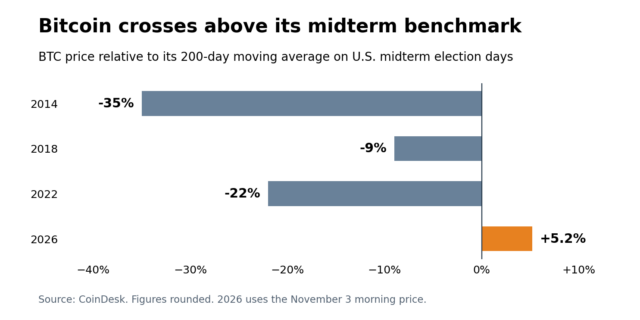 ell different stories about the same trade.
Bitcoin Gained After All Three Midterms. This Time It Has a Head Start
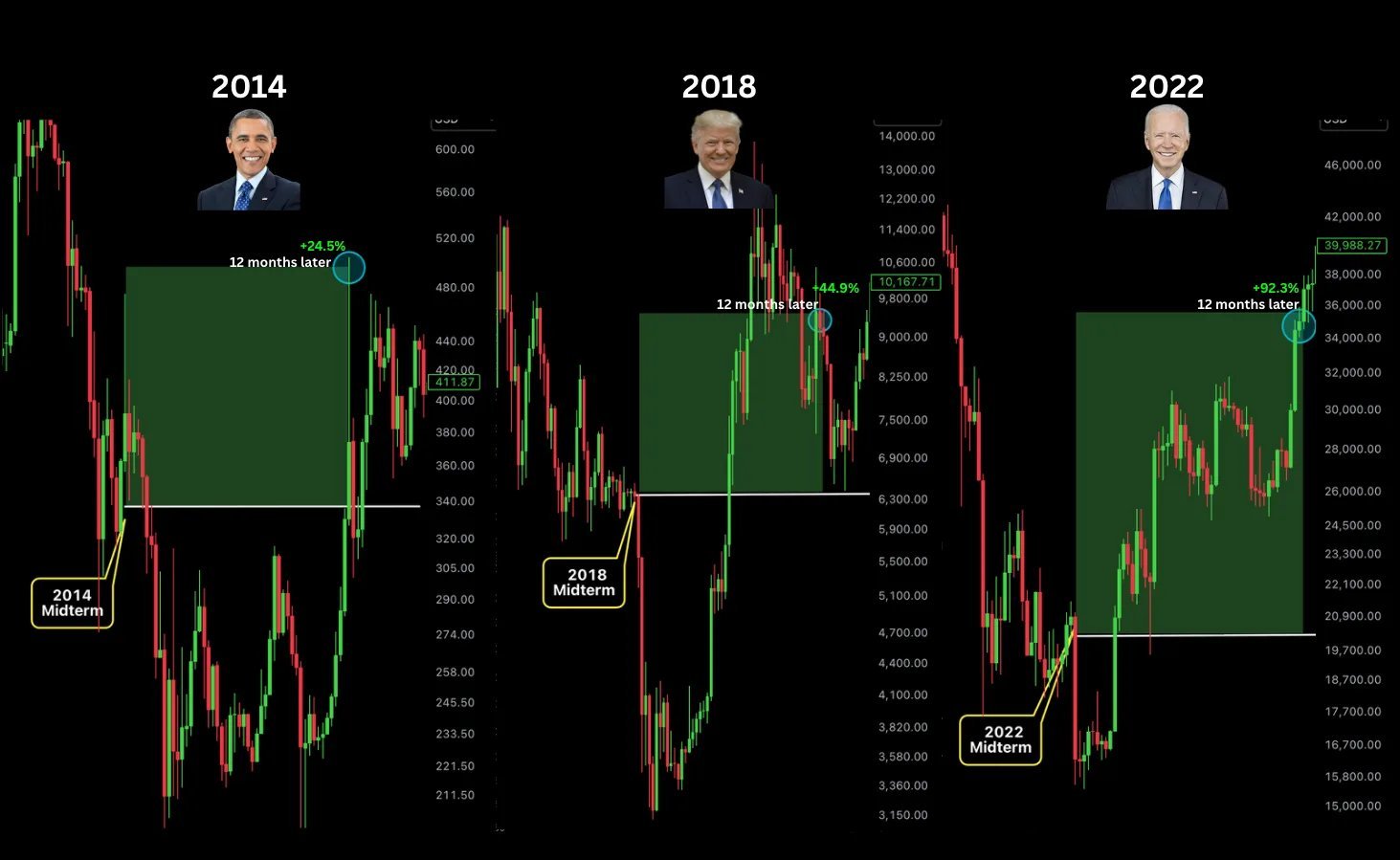
Bitcoin finished higher one year after each of the 2014, 2018 and 2022 midterms. Across those three periods, the average gain was 53.7%, measured from the election-day close to the close on the same date a year later, according to CoinDesk. The calculation excludes 2010, when Bitcoin’s market was tiny and its outsized return would have distorted the comparison.
The intriguing part is where those rallies began. In all three cases, investors entered election day with BTC still below its long-term average. This year, part of the recovery has already happened. That makes 2026 a chance to see whether Bitcoin can extend an established recovery after the midterms. Three elections offer little basis for turning that 53.7% average into a price target, especially since all three also fell at similar points in Bitcoin’s four-year halving cycle.
Source: AshCrypto / X
Why Friday’s Jobs Report Could Tell Investors More Than Election Night
The next date to circle is Friday, November 6, at 8:30 a.m. Eastern, when the Bureau of Labor Statistics is scheduled to release October’s employment report. The payroll figure gives traders fresh evidence to weigh against expectations for Federal Reserve interest rates. It also gives Bitcoin a second test in the same week, after markets have had time to absorb the election results
There’s a practical way to read Friday’s reaction. If BTC briefly reclaims $77,000, that will make an easy headline. If it finishes the week above its updated 200-day average after both the election and the payroll release, investors will have something more informative: evidence that Bitcoin’s strongest midterm starting position since 2014 held up through two very different tests.

Editorial Process for bitcoinist is centered on delivering thoroughly researched, accurate, and unbiased content. We uphold strict sourcing standards, and each page undergoes diligent review by our team of top technology experts and seasoned editors. This process ensures the integrity, relevance, and value of our content for our readers.